

PhD blog

blog with tips for a successful PhD

May 2, 2013
by admin
0 comments

do less, achieve more

Are you getting more and more busy? Do less! That’s the advice of Laura Stack, author of ’What to do when there’s too much to do’.  If you put in overtime as a rule – as a lot of academics do – whilst you are already busy, you are on the wrong track. In fact, you only become less productive, instead of more productive.
Recently I read an article about her book in ‘Psychologie magazine’. The main information about her method you’ll find here.


To get the work done that needs to be done, Stack says you only need 4 steps:

1. Decide what is really important

  • delegate tasks that don’t belong to your job description
  • work wiht 2 to-do listst: on the ‘main list’, you put the tasks that need to be finished in the long term, on your ‘daily list’ you put the tasks that you want to do that day. For instance smaller tasks from the bigger projects that are on your main list. At the end of each working day you put a few of the tasks that are on your main list on to your daily list for the next day.
  • make a ‘not to do list’ and put everything that takes a lot of time, but doesn’t bring you so much. Like revising and rewriting that paragraph endlessly, or checking email and Facebook every hour or more.

2. Schedule time

  • learn new daily routines, like schedule the time when you write, the time when you meet, the time when you check your mail. Do dificult stuff in the morning, the easier stuff in the afternoon. In that way you take your energy levels into account
  • make sure you have short term deadlines, that helps to not procrastinate
  • don’t go to that meeting every once in a while, and if you do go, make sure the time to finish is very clear

3. Make sure you are not interrupted all of the time

  • have ‘no speaking’ or ‘silent’ time with your colleagues, for instance in the morning when you have the biggest amount of energy
  • make sure you are the one who decides when to be disturbed, multi tasking is not productive. Switch of your email, Facebook and phone, read messages at certain scheduled times and let colleagues know when you are available and when not.
  • beware of your pittfals, just act and do. Productivity is more important then perfection, improving stuff is always possible in a later stage.

4. Be efficient in digesting information

  • jot down good ideas immediatly
  • make sure all the ‘loose ends’ are not in your head, write them down
  • if you can finish something immediately, finish it. If it takes longer then 3 mintues, put it on your to do list. A proven method by productivity guru David Allen of ‘Getting things done’.
  • keep improving your own system, make sure to make difficult tasks easier or ask someone who actually enjoys a task to help you

Let me know if this is working for you!

April 9, 2013
by admin
1 Comment

Spring cleaning in your head

Does this happen to you as well? That you have so much on ytour mind that you get lost. That you feel like you can’t focus anymore? Then
it is time for a spring cleaning! Not only the physical one, but also in your head. A research from 2008, publiced in the Journal of Personality and Social Psychology, showed that if you have to make too many choices, you are less able to focus. And you are getting worse in finishing what needs to be done and are less able to perform complex mental tasks. Daily tasks for a PhD student!

Almost 400 people joined 7 experiments where they were asked to make choices or rate different products. The more choices people had to make and the more time they spent deciding, the worse they performed with anything they had to do afterwards. Even if the choices were simple, they turned out to be a huge influence on everything afterwards. Recognizable?

So because of all the choices you have to make, you can’t focus anymore.

Luckily there are some simple trics to help you with that.

A first step is to ask yourself what would be possible if you were truly focused. And then I’m not just talking about your job, but about all other aspects in your life as well. Would your life look different? What would be different? See if you ca get clarity about that.
Take a few minutes to do so, en visualise you are truly focused. What does that look like? How do you move? Where are you? How do you sit? How do you relax? How do you behave? How do you talk? What are you doing?

Probably a visualisation like this can help you to identify a few things you want to do differently. Well done! Choose 1 or 2, write them down on a sticky paper en put it in a place where you can see it. That will help you to remind the 1 or 2 things you want to change. Don’t try to change to much, because that will make focussing much more difficult.


Another important step: have a spring cleaning!
How? By making what is called a ’masterlist’. What is a masterlist? It is a list where you put on ANYTHING, really ANYTHING that is going on. If it is in your head, it is important. So, if anything crosses your mind, write it down. Do a proper braindump about anything that is going on. All loose ends, all jobs that need to be taken care of, appointments that have been postponed, that call you still need to make, that pile of paper that needs sorting… Put effort in making the list, and make sure you finish the list within a week.
The next step is to get yourself a big box: put all ‘stuff’ you’ll find in there, things that need to be done, so you gather everything in one place. Simply walk through your home or check your working place and collect everything. In that way, things are no longer spread but in one place. The advantage: everything that is everywhere is disctracting, it helps to be more focussed.

The walking around you can do literally, but also mentally. That brings you back to your masterlist: thiing about anything that has to do with your PhD, what is it that you don’t want to forget, that still needs to be done?

Don’t think about job ‘stuff’ only, also think about other aspects of your life: what still needs to be done as a partner, a friend, a parent, a …?

By gathering all the information on your masterlist and in a box, it becomes visible what is actually present all of the time in the back of your mind and asks for attention. By making all the ‘ stuff’ more explicit you create an overview and you can make decisions about what you want to do with it. It is like a broom through your house, your workplace and your head.

And then what? What to do with the list and the box? Make sure you make it manageable. Ask if there are things on your list that are there for already such a long time, that you’d better get rid of it. Look if you can make a distinction between things you need to do immediately and things that can wait for a while. Can you cluster things, or turn them into a small project? Then look what tasks belong to this project. Order if possible.

The next step is easy. Get yourself a timer and take 2 times a day 10 minutes to get rid of part of the list or empty out part of you box. Keep on doing that for a while and – depending on the length of your list – you made sure you got rid of all the loose ends, made decisions about things that were in your head all of the time. No loose ends, empty head, focus is back!

Please let me know how this works for you!

Picture via Flickr, met dank aan Ryan Harvey

March 6, 2013
by admin
1 Comment

How to not get lost in your text

For a lot of PhD students it is difficult to keep an overview on all the texts they are writing for their thesis or articles. You have a lot of different versions of your text, comments, in between versions, draft versions, documents with notes and remarks, summaries, references… In short: enough to get a lot of stress. And that is of course not what you want.

Luckily there is a solution, a kind of super word processing program that solves your problems. It is a program that I already promote for quit a while to people who follow my writing courses. It is called Scrivener. Not too long ago, I received enthusiastic responses via Facebook and Twitter from people who actually use the program, so I thought to share it with you as well. I hope you will be as enthusiastic about it as I am and they are: I think the program is of great value for a very decent amount of money (about $45,-).

What is Scrivener?
In short: it is a very handy word processor, with a lot of extra possibilities compared to for instance Word.
It comes in a windows version: Buy Scrivener for Windows (Education Licence)

And in a version for Mac: Buy Scrivener 2 for Mac OS X (Regular Licence)

Both versions have the same possibilities, and it is a lot of them. The easiest way to find out is to watch this video with all the possibilities. You have to take your time, because this video is 35 minutes. But I can assure you it is worthwhile. If you want a shorter video, just search for Scrivener on YouTube, and you will find a lot of information.


(or click here for the video)

Also good to know: Scrivener can be combined with for instance Endnote. And thanks to YouTube, a video about that as well.


(or click here for the video)

They have a good offer for a free trial: you can use Scrivener for 30 days. And that means: actually 30 days. If you use Scrivener one day, you still have 29 days to go, even if that takes days or weeks before you use it again.

Mmmh, sounds like a commercial… ;-)

November 15, 2012
by admin
2 Comments

How to have a good meeting with your supervisor

A lot of PhD students complain about the meetings with their supervisor: they don’t get the feedback they need, they are overwhelmed by all the tips they are getting but don’t know how to use, they are getting lost because their research needs to go into a different direction all of the time, they feel they are treated like a child….
And you can probably give a few more examples yourself.

So what can you do to make sure the meetings with  your supervisor work out as well as possible? A few pointers:


  • How is your own inner stance? Do you feel like an equal interlocutor? Why or why not? And how does that influence the conversation?
  • How did you prepare for this conversation? Is it clear for you what you want to know? Do yo know what kind of feedback you want to have? And in what way?
  • Is it clear for your supervisor what you want? Did you make that clear to him or  her? Does he or she know what questions you have?
  • Did your supervisor have had enough time to prepare for the meeting? What kind of input have you delivered? In what way? And what kind of pointers did you add that what you handed in? Or do you somehow expect your supervisor to read your mind?
  • If you are meeting to discuss text: did you make clear what the status of your text is? First draft, almost finished, somewhere in between? Have you made clear upfront what needs to be revised? Have you made clear on what exactly you want commentary?
  • Did you make a program for the meeting? Does your supervisor know?
  • Have you thought about what to say if your supervisor is going to mount his hobbyhorse again?
  • Have you thought about what you can say to steer to conversation in the direction you want it to go?

A good preparation is half the work, as we say in Dutch. The better you prepare yourself, the more you know and the more you are able how steer the conversation, the bigger the chance you can actually talk about the things that are imported to you! And then you can walk out again with all the input you actually need.

Hope to hear how your meetings went!

photo via Flicker, with thanks to Jozoana

October 25, 2012
by admin
3 Comments

Thé best tip to write more effectively

Often I am asked what the most important tip is for writing effectively. Of course there is a lot to say about that, you can become more effective in many different ways, but the most important thing you definitely need to do is to separate the different phases in writing. What do I mean with that?

A lot of PhD students just start writing. They sit down at the computer, type a few bits and pieces, read again, look for some literature, do some cutting and pasting, rephrase a sentence or two, think of a new title, work on their conclusion, notice that their theoretical framework is not yet complete so do some more research and think about the implications for the method section, analyse their data a bit further and then have to go back to their framework again…

This description might be a bit exaggerated, but it is what I see happen very often. Most PhD students do a little bit of everything. They are – so to speak – juggling with to many balls at the same time; they are busy with:

  • rephrasing
  • working on the structure of the text
  • getting clarity on argumentation
  • checking literature
  • thinking about the content
  • wondering whether they need more information or if they have already enough
  • rephrasing titles
  • changing paragraphs
  • wondering if the different parts they wrote really fit together
  • asking themselves what their supervisor will say about their text
  • scrolling back and forth through their text
  • changing the order in the text
  • checking their grammar
  • writing up their figures and tables
  • analyzing their results
  • looking for new literature
  • polishing up their lay out

And I can expend on this, you probably as well….


You can imagine that it is not very effective and efficient to be busy with so many things at the same time, it makes your brain spin, you simply cannot handle all those things at the same time. It is like juggling with a lot of balls at the same time, virtually impossible for almost everyone. Juggling with two or three balls, that might be doable, but not with more…

So what you need to do to write more efficient and effective, is to divide the writing process in different phases. And those phases are actually quit straightforward; they are called preparation, (free) writing en revising.

What is what?
Preparation means thinking about your structure, finding literature, thinking about your audience, knowing what goal you want to reach with your text, making sure you know the deadlines, planning. So preparation is everything you need to make sure you can actually start writing.

If all goes well, you will have a design for your text when you have finished preparing. And the more detailed your design, the easier it is to write. So it is very helpful for yourself to not only write down a few key words as your design, but to actually make a detailed table of contents or some kind of ‘construction plan’. There are a lot of books in which you can find different methods for that.

In the next phase, the (free) writing, is is important that you write as fast as possible. Not producing perfect sentences and paragraphs, but actually filling in your design as fast as possible. No worries about grammar, style and so on. Because that belongs to a different phase: the revision. Whilst writing, all you do is jot down everything that should be on paper, based on your design.

When revising, you start to correct your text at different levels: you look at the structure as a whole (is the design I made visible in my text?), you look at paragraphs (are my paragraphs actually paragraphs, according to the rules?), you look at sentences, at grammar, spelling and lay out.

If you divide your writing in those small portions, and actually start to write according to the different phases in the writing process, you turn writing into manageable tasks; you are able to juggle with a few balls at the same time, instead of trying to keep all balls in the air!

And it’s a guarantee: working like this makes you much more efficient!

photo via Flickr, many thanks to Helico

October 8, 2012
by admin
0 comments

Little things matter

There is this Toni Brixton song called ‘Little things’. Dont’ ask me what I think of the music, but the lyrics inspired me to write this blogpost. This is the song I’m talking about:

Why do little things matter? Because they can make a huge difference. What kind of small things am I talking about? This is a list of small things that can make a big difference:

  • How do you leave your desk when you are finished working? How does that help you when you want to start again?
  • How do you start your day? Does that help you to have a good day? (read for instance the blog of Eva Lantsoght on ‘morning routines)
  • How do you close of a conversation?
  • How do you talk to yourself when things go well?
  • How do you talk to yourself when things are not so well?
  • Do you get enough sleep?
  • Do you eat well?
  • How much relaxation time do you have?
  • How do you start a conversation?
  • How do you prepare yourself for a task?
  • Do you ever reward yourself?
  • How kind are you towards yourself?
  • And towards others?
  • Do you get enough exercise?
  • Do you rest enough?
  • Do you make your work as easy as possible for yourself?
  • Do you plan well?
  • Is there enough time for fun?
  • Do you give compliments?
  • How do you finish what you are doing? Does it help to continue?
And this is only a little list of little things. Maybe you can make your own list with little things that will make a big difference. Because, baby, the little things are things that matter to me…
Feel free to respond! Am looking forward to your list!

September 24, 2012
by admin
Comments Off

How to become more effective

Your daily schedule is a big influence on your productivity and effectivity.  With that, probably I don’t say anything new to you. And the interesting questions is of course how to plan your day in such a way that you are as effective as possible and don’t get stressed out. Especially after the holidays you feel often better how fast you get back into a certain track that is actually not so useful and that makes you loose all the relaxation you found during your holidays. Like you have never had a holiday at all.

An important help for that: know your own rhythm! What do I mean with that? Make sure that you know how you are at different moments of the day. Do you wake up shiny and radiant, or do you need 5 cups of coffee before it is safe to talk to you? How about your after lunch dip? At what time are you the most creative? What is the best moment to work very concentrated? What is a good time for meetings? A lot of people are not aware enough for how this is for them.

An easy way to create clearity in this, is to keep track of your days for a week or 2.  Give every part of the day (morning, afternoon, evening and night) a grade and see –after a week or 2 – if you can see a pattern. Is it the case that your grades are higher in the middle  of the week? Are your mornigs better then your afternoons? Do your score better when you are at a certain place? Is there a relationship with the people you meet? How about the kind of tasks you are performing?

See what you can find out for yourself. The more specific you can be, the better!

Four kinds of jobs on four different moments of the day

As a PhD-student you have different kind of jobs and tasks to do. Often, you can roughly divide them into four types: solving problems,  using your creativity, sorting things and act upon that and planning. What can you do best when? You can also divide your day into four parts. A schedule that works for a lot of people:

Solving problems: 8-10 (or a bit later of you wake up later)
Tasks you need your brain for, you can best do when you start. You are still fresh. Reading could be one of the things that fit in here as well, you also need your head for that to see what you can use your reading for.

Using your creativity: 10-12
After being busy for a few hours, your brains are warmed up. A good moment to see if you can do something new, getting clearity in your thoughts. Free writing can be an enormous help to get that clearity.

Sorting things and act: after lunch
The time after your lunch is a good time to be busy: for instance with data analysis – if they are the kind of analysis that don’t take to much of your thinking. So dome some sorting that doesn’t require too much thinking. Do work you can be busy with, so you don’t fall asleep: answering emails, organizing paperwork, making phonecalls, those kind of activities. Make sure you do activities that you can be busy with.

15.00 This time is a great moment for meetings: you can do something different, and are still fresh enough to keep your mind with it.

Planning
Use the last hour of your working day to plan the activities for your next day. Make sure that you know what to do in your ‘problem solving time’ and in your ‘creative time’.  Usually it is no problem whatsoever to fill your afternoon with all kinds of activities that need to happen.

The main reason to plan is to make sure you can make a kick start the next day.

Hope to hear from you if this is helpful for you! Or do you have another schedule that works for you? Please share!

Foto via Flickr, thanks to Alan Cleaver

July 16, 2012
by admin
Comments Off

the secrets of revising

Good writers make sure they divide their writing in different phases, because of efficiency and effectivity. Without going into all the different phases of the writing process (I will do that in another blogarticle, or if you can read Dutch, you will find information about that here), you might know that revising is one of the main phases in the writing process.

One of the biggest secrets of good writing is that the more you revise, the clearer, more fluid, and more natural your writing will be. With revising it’s not about inspiration, but about hard work. That is the only way to get readable text. And what might be good to know: revising takes as much time as writing your first draft, so don’t forget to plan enough time for the revising bit.

A warning: only start revising when you are more or less sure that your text is going to be in your thesis or article in this form; don’t start earlier, because chances are big that you will change your text again, and that you are doing a lot of unnecessary work.

Here you will find a list of revising tips that might help you. It is based on the book ‘Writing your dissertation in fifteen minutes a day’ from Joan Bolker.

- Consider leaving the revision of both the introduction and the conclusion until last

- When you are unsure of your argument, try making an outline of what you have. Problems show up much more easily and clearly in an outline form, as well as in the process of making the outline.

- Use the outline also on a smaller scale: try reducing each paragraph of a chapter or article to one sentence. When you can’t do it, you’ll discover your paragraphs are incomplete or fuzzy. By writing one sentence to cover each paragraph you’ll be able, by looking at the sentences you’ve created, to scrutinize the flow of your argument.

- Leave editing at the individual word level for last, unless the word that concerns you is one crucial to your argument.

- Similarly, leave smoothing out the transition from paragraph to paragraph for a late stage, because paragraphs will come and go, and they will move around as you work your argument. There’s no pint in making an elegant transition you won’t be able to use.

- Have someone else read your work and look for phrases that you’ve unconsciously overused or arguments you’ve repeated. It’s hard to notice such thing when you’ve written them.

- Keep a thesaurus, a dictionary, and a style manual at hand when you’re revising. Check out with style manual is standard in your own field.

- Don’t use complex language or jargon when simple words will make your point equally well. Rather than using putting-on-airs language, go for elegant simplicity.

- When you think you are done editing, read the chapter or article again. And then again. It is amazing how many times you can go round and still catch errors or infelicities you’d be embarrassed to discover in the finished work.

- Remember the saddest rule of editing: less is more. Delete any word that isn’t necessary (particularly adjectives), and you’ll strengthen your point.

- And, paradoxically, realize you’ll never get your dissertation perfect, that at some point you have to quit fiddling with it and send it off into the world.

Will you let me know if you have any additions to this list? Please let me know!


Foto via Flickr, thanks to mpclemens

May 11, 2012
by admin
Comments Off

This is how to plan! (and have a lazy summer)

Planning, time management is a skill a lot of PhD-students struggle with. In this blog a few tips on how to plan well.

On top of the chart:

Never plan more then 80% of your rime.

The rest of the time will fill itself with unexpected things that need to happen: a colleague walking in, the meeting that takes longer, the things that take longer then expect.

2. Is clear for you which tasks you need to do and how these different tasks are connected?

Map that out for yourself. Divide big tasks into smaller once. The writing for an article for instance can be divided into the following smaller tasks:

  • summarize your literature
  • get the structuren of your text clear
  • make sure the content gets on papier, so free write
  • make charts
  • revise the literature list
  • discuss your text with other
  • rewrite your text
Realise that you have tasks that are connected to your research, with other aspects of your job (teaching, meeting, organizing conference) and with your personal life.
Also ask yourself which different tasks you will have in the different phases of your research.
3. Plan backwards.
Make sure you know when the deadline is, en then plan from there. In the case of writing a paper for a congress for instance, it is often the case that the paper needs to be submitted a long time in advance, you need time to make revisions, writing full time is not possible, your abstract need to be accepted, you need the data for your paper, and so on, and so on. Make sure you have all the tasks clear, and plan them in time. Often you will notice that you will need more time for a task then you expected.
In the case of writing a paper for a congress, you often need to talk to your supervisor a year (!!!) in advance whether to see if it is a good idea to write an abstract and a paper. You will really need that time!
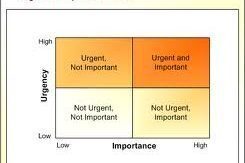
4. Use the Eisenhower matrix
The American president Eisenhower is supposed to have said that urgent matters are not very often important ones. Eisenhower is considered to be a master in time-management: doing the right things at the right moment. The Eisenhower method helps you to divide important and urgent tasks. It doesn’t matter what you need to do: always start with filling out the Eisenhower model and then decide what to do when.

Often we focus on the urgent but not so important matters. But when do you give yourself the time to do the important things, before they become urgent?

A video on how to improve your planning with the Eisenhower-matrix:


5. Use the Warren Buffet-method

According to Warren Buffet, the multimultibiljardair, this is a good time to plan: make a list of everything you want to do today. Start with the task on top of the list. Don’t continue before you have finished that task. When you have finished a task, cross it off.

And maybe the most important tip: be realistic in your planning. Nothing is more frustrating then having more things on your to do list then you can actually do. Keep that in mind whilst making a plan.

Hope this helps you to plan your time in such a way that you will have a lazy summer. Hope to hear if that worked out.

March 20, 2012
by admin
Comments Off

Short enough to read now (and not procrastinate)

Procrastination. Yes, you suffer it. I’m sure. And I have a simple way to get rid of it, of that procrastination. Tool: egg timer.

What to do? Sit down at the place where the task needs to be done. Get your egg timer and set it on 10 minutes. I know fore sure you have 10 minutes. Put the timer on, do what needs to be done.

Did the 10 minutes go well? Good for you! Put the timer on 10 minutes again and work for 10 minutes again. Reward yourself with something nice.

Do you want to do it officially? Look here , there this technique is described, it’s called pomodoro technique. There is also a link to the official website.

Why I use 10 minutes instead of 25? Ten minutes are doable, for everyone, 25 can be a lot.

Just do it. It works!


Photo via Flicker, thanks to tanakawho.